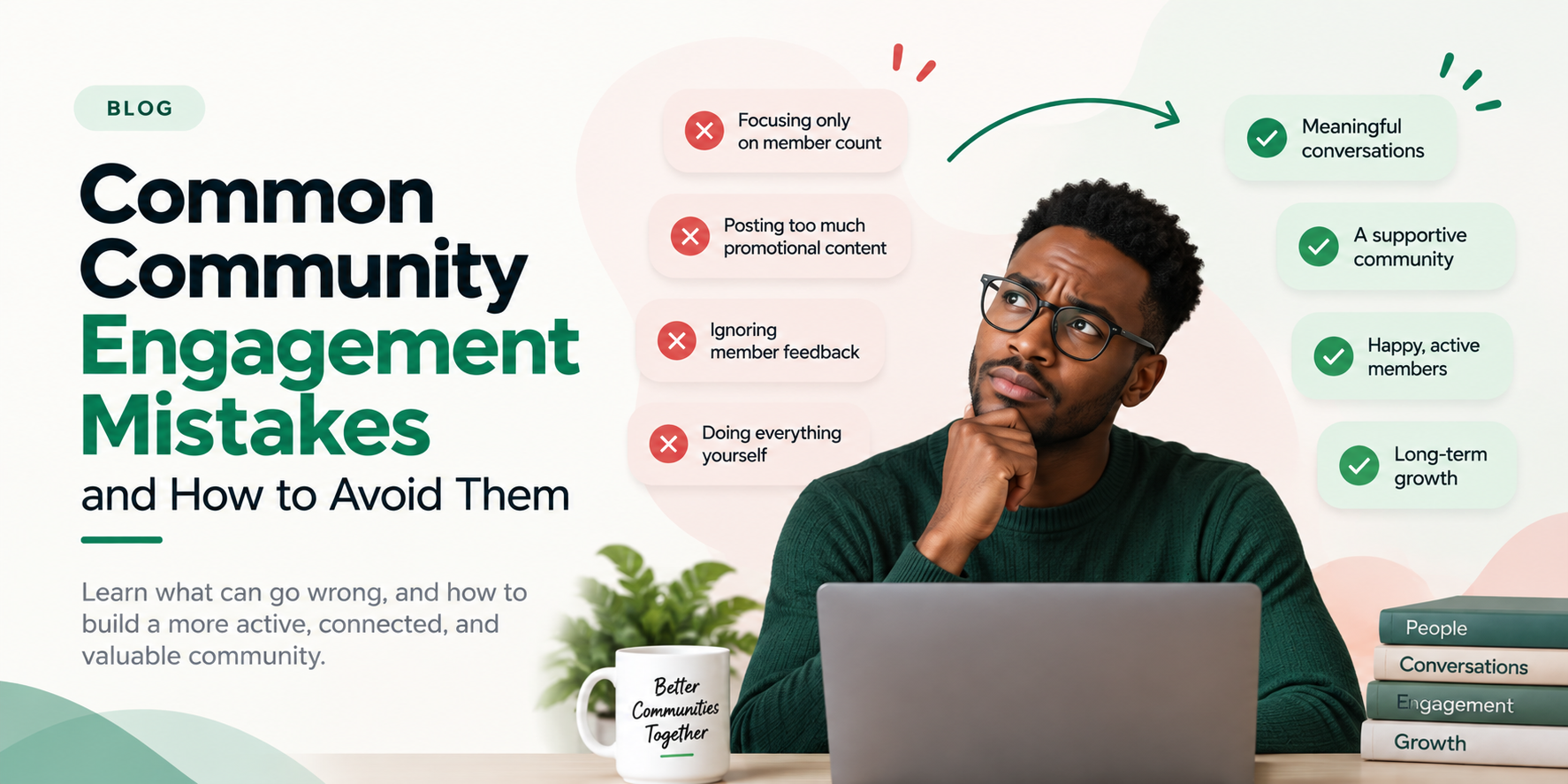
Common Community Engagement Mistakes and How to Avoid Them
Discover the most common community engagement mistakes and learn practical ways to build a more active, connected, and valuable community.
Common Community Engagement Mistakes and How to Avoid Them
Building a community is exciting. You create the page or community, invite your first members, start sharing content, and watch the numbers grow.
Then something happens. People stop responding. Discussions become quiet. Events get fewer attendees. Your posts get views but very little interaction.
If this sounds familiar, the problem may not be the size of your community. It may be how you're engaging the people already in it.
In our previous article, Community Engagement, we explored what community engagement means, why it matters, and the strategies community owners can use to create active communities. In this article, we'll look at the mistakes that can quietly kill engagement and, more importantly, how to avoid them.
1. Focusing on Member Count Instead of Engagement
One of the biggest mistakes community owners make is treating the number of members as the most important metric.
Having 10,000 members sounds impressive, but if only 20 people participate, you don't necessarily have a healthy community.
A smaller community where members actively ask questions, attend events, share ideas, and help one another can be much more valuable.
How to avoid it
Start measuring active participation, not just membership growth.
Look at how many members are contributing to discussions, attending events, responding to posts, and returning regularly.
2. Making Everything About You
Your community may have started because of your personal brand, business, or expertise. But that doesn't mean every conversation should revolve around you.
If every post is an announcement, promotion, lesson, or update from the community owner, members can quickly become passive consumers.
How to avoid it
Create opportunities for members to contribute.
Ask questions. Invite opinions. Encourage members to share their experiences. Give them opportunities to showcase what they're building and connect with one another.
3. Posting Too Much Promotional Content
Nobody joins a community because they want to receive advertisements every day.
Constantly promoting your products, services, courses, or events can make your community feel more like a sales channel than a place for people to connect.
How to avoid it
Follow the value-first principle.
Give members useful information, opportunities to connect, educational resources, conversations, and experiences before asking them to buy something.
When members trust the community, selling becomes much easier.
4. Creating Content Without a Purpose
Another common community engagement mistake is posting simply because you feel you need to post something.
A community doesn't need more content. It needs meaningful reasons to participate.
Before creating a post or activity, ask:
"What do I want members to do after seeing this?"
Do you want them to share an opinion? Ask a question? Meet another member? Learn something? Attend an event?
Having a clear purpose makes your community activities more intentional.
5. Ignoring Member Feedback
Your members are one of your best sources of information.
They know what they enjoy, what they struggle with, what they want to learn, and what could make the community better.
Ignoring that feedback means you may spend time building things nobody actually needs.
How to avoid it
Create simple ways for members to share their opinions through surveys, forms, polls, discussions, or direct conversations.
And don't just collect feedback.
Act on it.
When members see their suggestions influencing the community, they feel a stronger sense of ownership.
6. Expecting Members to Engage Without Giving Them a Reason
Simply telling people to "engage more" rarely works.
People participate when there is something meaningful in it for them. That could be an opportunity to learn, meet someone, solve a problem, get feedback, showcase their work, or contribute to something they care about.
How to avoid it
Think about the member's motivation before creating an engagement activity.
Instead of:
"Introduce yourself."
Try:
"What are you currently building, and what's the biggest challenge you're facing?"
The second question gives people something meaningful to respond to and creates opportunities for other members to help.
7. Trying to Do Everything Yourself
If the community manager is the only person creating conversations, answering questions, organizing activities, and providing value, engagement can quickly become difficult to sustain.
A strong community eventually develops its own contributors.
How to avoid it
Identify active members and give them opportunities to contribute.
They could host discussions, answer questions, organize meetups, share resources, or welcome new members.
Your job isn't to be the only source of value.
How to Build a More Engaged Community
Avoiding these mistakes is only one part of the equation.
You also need a deliberate community engagement strategy built around your members' needs.
Start with a clear purpose. Give people reasons to participate. Create recurring experiences. Encourage members to connect with each other. Recognize contributions and, most importantly, listen.
Build and Manage Your Community With Gamms
Managing community engagement can become complicated when you're using different tools for discussions, events, forms, emails, memberships, and member management.
Gamms brings these activities together in one platform, giving community owners and managers the tools to create better experiences for their members.
You can create discussions, organize members, host events, collect information through forms, send community emails, create dedicated spaces, and spotlight members—all while keeping your community experience connected.
The goal isn't simply to build a bigger community.
Final Thoughts
The biggest community engagement mistakes are often simple: focusing too much on numbers, talking instead of listening, promoting too much, creating content without purpose, and expecting members to participate without giving them a reason.
You don't need to fix everything at once.
Start by understanding your members better. Give them meaningful opportunities to participate, create space for them to connect with one another, and consistently deliver value.
Because at the end of the day, an engaged community isn't created by posting more. It's created by giving people something worth coming back for.
More reads
Community Manager Skills: 5 Skills You Need to Succeed
Learn the skills you actually need to become a successful Community Manager
How to Become a Community Manager: A Complete Guide
Learn how to become a community manager, the skills you need, how to gain experience and how a community management course can help you start your career.